
In the middle of Bristol there is an empty plinth with two plaques on it, and I think it may be the most honest object I have seen in a British city.
The statue that used to stand on it was of Edward Colston. It was erected in 1895 and pulled down during a protest on 7 June 2020 before being rolled into the harbour. It was later recovered and is now held by a museum; paint is still visible on it. The stone it stood on was left behind.
The original plaque is still there, describing Colston as one of the most virtuous and wise sons of the city. Beneath it, a second plaque added in 2025 explains that Colston was celebrated as a generous benefactor, but that his involvement in the trafficking of enslaved Africans became increasingly recognised, his legacy became contested, and the statue was pulled down and recovered from the water.
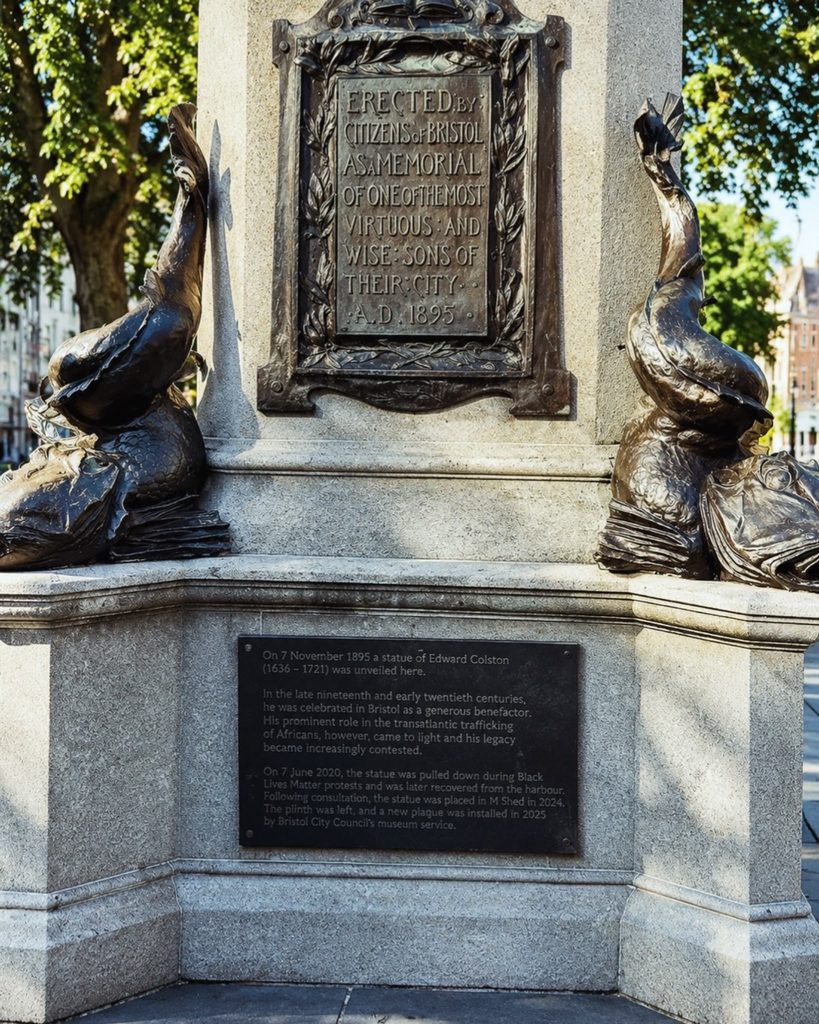
The old words were not removed. The new ones were placed underneath them.
You cannot read one without the other.
That is what has stayed with me. The easy thing would have been to remove the old plaque. It praises someone whose wealth was connected to the Royal African Company and the trafficking of enslaved Africans. It uses the word virtuous to describe him. Instead, Bristol left the uncomfortable words where they were and added something underneath them. Not a replacement. A correction.
We do not often do this. When organisations change their position, the old version usually disappears into an archive. Websites are updated. Statements are rewritten. People move on.
We do it as individuals too. A painful period becomes “a difficult time”. A failed relationship becomes “we grew apart”. An opinion we once held confidently becomes something we “used to think”.
There is a difference between moving on from the past and rewriting the past, and the plinth made me think about that difference. Some of this is healthy. Not everything needs to be carried forever, and people need the freedom to grow, change and move on. But growth does not require the earlier version to disappear.
The statue was removed. The public honour was removed. But the evidence that the honour once existed was not. That matters, because remembering something happened is not the same as celebrating it. A museum holding the statue does not mean Bristol still honours Colston. A plaque explaining why the statue once stood there does not mean the city agrees or disagrees with the people who erected it.
Sometimes the most honest way to move forward is not to erase the earlier version of ourselves but to place it in context.
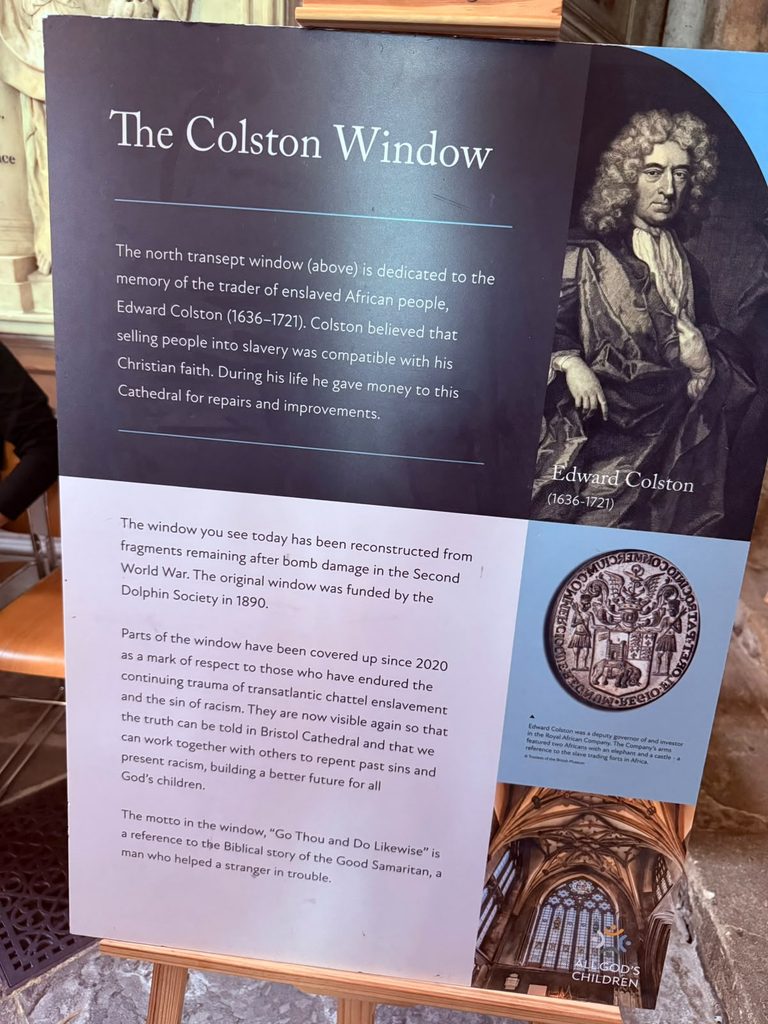
There is a similar example inside Bristol Cathedral. A window dedicated to Colston, funded in 1890, was partly covered in 2020 and later uncovered alongside an explanation of its history and his connection to the building. Again, the choice was not simply between keeping the celebration and destroying the evidence. There was another option:
Keep the object; change the context.
That distinction is important, because the uncomfortable part of the Colston story is not simply that people in 1895 did not know what he had done. The essential facts about his involvement with the Royal African Company and the trafficking of enslaved Africans were part of the historical record long before the statue was erected. What changed was not the evidence, but the willingness to treat it as disqualifying.
The more difficult question is why those facts did not prevent him from being celebrated.
That is where the story becomes less comfortable. It is easy to look backwards and ask, How could they not have seen it? But perhaps the better question is: what are we seeing today that we have not yet learned to recognise as a problem?
Every generation inherits things that seem normal. Some of them remain normal. Some eventually become unacceptable. And some are only questioned when the people affected by them, or the people willing to challenge them, become impossible to ignore.
We cannot know which things in our own time will eventually require a second plaque. That is the humbling part. The people who commissioned the first plaque were probably not sitting around thinking they were creating a monument that future generations would find disturbing. They were doing something that their society allowed them to see as respectable and honourable.
They put that judgement in bronze.
Perhaps the lesson is not that we should never forget anything. Perhaps it is that we should be careful about why we want to forget. There are things we should leave behind because they no longer belong in the present. There are things we should forgive. There are things we should stop carrying. But there is also a danger in making the past disappear simply because it makes the present uncomfortable.
The two plaques offer a different possibility. The first tells us what Bristol once chose to say. The second tells us what Bristol later came to understand. Neither cancels the other.
Perhaps that is why I find the plinth so honest. It does not ask us to live in the past. It asks us to move forward without pretending the past was different from what it was.
Two plaques. One stone. A record of what we once believed, and a reminder that what feels normal to us today may not always remain so.